Electrifying Go-Ahead’s Plymouth bus depot support new zero-emission fleet
Published: 7 May 2026
Project summary
Go-Ahead Group required a major electrical infrastructure installation at their Plymouth bus depot to support the introduction of a new fleet of zero-emission double-decker buses.
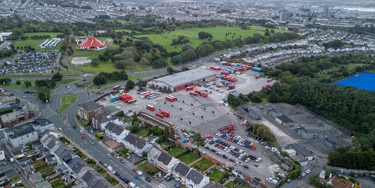
As part of the government-funded Zero Emission Bus Regional Areas 2 (ZEBRA2) programme, the depot needed a robust, future-ready charging solution capable of powering 50 electric buses while maintaining full operational continuity. The site operates 24 hours a day, meaning any disruption to bus movements, charging or depot access would have significant operational consequences.
Existing electrical infrastructure was not capable of supporting the required load, and the site’s constrained layout demanded careful planning to integrate new high-voltage and low-voltage systems, charger islands, and cable routes.
As construction progressed, additional issues emerged such as contaminated ground, asbestos, and the depot’s location within a high-risk area for unexploded ordnance due to historic WWII bombing. Despite these complexities, the project needed to be delivered safely, efficiently and in line with Go-Ahead’s sustainability and social value commitments.
Project details
Client: Go-Ahead

Approach and implementation
We acted as principal contractor, taking full responsibility for the design, coordination, construction, installation, and commissioning of the new electrical infrastructure required to support Go-Ahead’s transition to a zero-emission fleet.
From the outset, our team worked closely with Go-Ahead to understand operational constraints, future fleet expansion plans, and the technical requirements of the ZEBRA2 funding framework. This enabled us to develop a delivery strategy that balanced engineering precision with the need to keep the depot fully operational.
Design and engineering
Working with our appointed design agency, we produced a comprehensive high-voltage and low-voltage design package that delivered power from the distribution network operator (DNO) point of connection through to the new charging infrastructure.
The design accounted for the significant electrical load required to charge 50 double-decker electric buses, and incorporated future-proofing measures to support additional chargers and increased capacity in later phases. This included modelling cable routes, load distribution, transformer sizing, and the integration of new low-voltage panels into the existing depot layout.
A bespoke lighting design was developed to meet Go-Ahead’s operational and safety requirements, ensuring optimal illumination across new charging and manoeuvring areas.
To ensure the installation did not impede bus operations, we also undertook a swept path analysis, validating that charger islands, lighting columns, and protective infrastructure would not impact vehicle movements within the depot.
As the project progressed, Go-Ahead instructed us to install an additional five 150 kW chargers. This required rapid design amendments, procurement, and integration into the existing programme without affecting the depot’s operational continuity. Our design team re-engineered cable runs, breaker configurations, and charger island layouts to accommodate the increased demand safely and efficiently.
Construction and installation
We delivered all civil, electrical and mechanical works required to build the new charging infrastructure. This included:
- Connection of the new transformer into the incoming high-voltage supply
- Civil works between the existing low-voltage site input and the new low-voltage panel
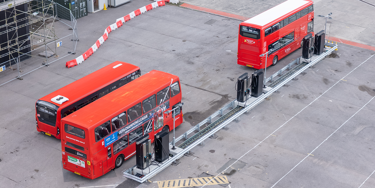
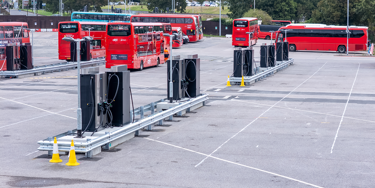
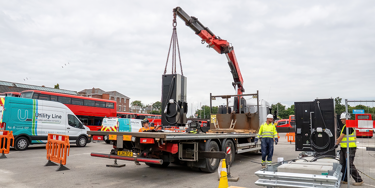
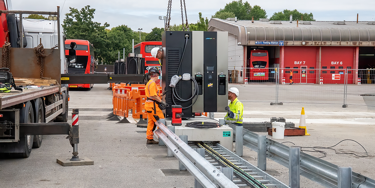
- Construction of a new charger island with full Armco protection
- Installation of new lighting across operational areas, supported by bespoke precast lighting bases manufactured using sustainable materials to reduce lead times
- Installation of cable runs from the low-voltage panel to the new charger islands
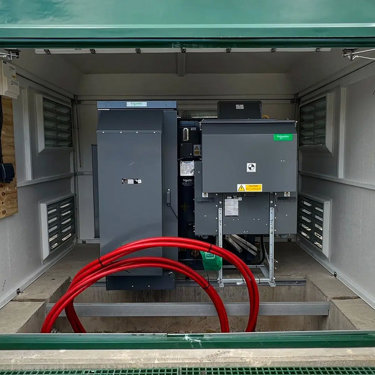
- Supply and installation of transformers and associated switchgear
- Supply and construction of a new low-voltage distribution panel with permitted breakers
- Connection between the transformer and low-voltage panel
- Replacement of the existing low-voltage supply connection
- Installation of wheel stops to support safe bus positioning
- Full site commissioning and energisation
To support Go-Ahead’s operational technology requirements, we installed fleet management system infrastructure – including a power meter for load management and communication cabling between chargers and the load management cabinet.
A bespoke cable management solution was developed, incorporating cable trays beneath the charger and lighting bases within the Armco islands. This ensured a clean, protected and maintainable installation while reducing trip hazards and improving long-term resilience.
Civil works also included road plaining, resurfacing, and new bay markings, ensuring the depot layout was optimised for electric fleet operations and compliant with safety and accessibility standards.
All works were carefully sequenced to ensure the depot remained fully operational. This required close coordination with depot management, phased isolations, and night-time working where necessary to minimise disruption.
Managing unexpected site conditions
During excavation works, several unforeseen issues emerged, including contaminated soil, asbestos, and the site’s location within a high risk area for unexploded ordnance due to historic WWII bombing.
We implemented enhanced safety protocols, engaged specialist contractors, and adapted the construction methodology to ensure all risks were managed effectively.
Despite these challenges, the project remained on-programme and was delivered safely and compliantly.
Social value delivery
As part of the ZEBRA2 funding requirements, we developed and delivered a comprehensive social value plan aligned with Go-Ahead’s Sustainable Procurement Supply Chain Charter. This included:
- Donations to local charity The Music Zone, a community hub in Plymouth
- Delivery of carbon literacy training to Go-Ahead staff
- Volunteer work supporting environmental community initiatives in the Plymouth area
These activities ensured the project delivered meaningful social, environmental and economic benefits beyond the physical infrastructure.
Impact and outcomes
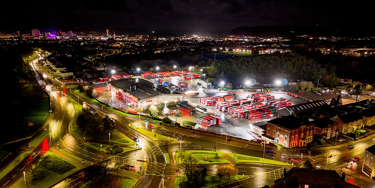
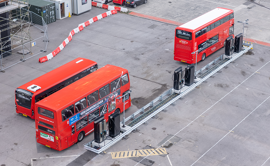
The Plymouth depot now benefits from a resilient, scalable electrical infrastructure capable of supporting 50 electric buses, with capacity built in for future fleet expansion. The new charging facilities have enabled Go-Ahead to accelerate their transition to zero-emission operations, reduce carbon emissions, and improve air quality for the local community.
Operational efficiency has also improved through better-designed charging layouts, enhanced lighting, optimised bay markings, and safer vehicle movements around the depot.
The project has strengthened Go-Ahead’s long-term sustainability strategy and demonstrated how complex electric vehicle infrastructure upgrades can be delivered safely and effectively within a live operational environment.
Other projects
 case study
Electrifying Go-Ahead’s Plymouth bus depot support new zero-emission fleet
 Projects
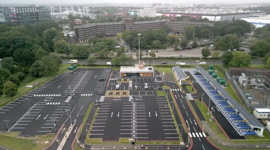
Infrastructure design and installation of 150+ chargers for large-scale electric vehicle charging hub at the NEC Campus, Birmingham for The EV Network
 Projects
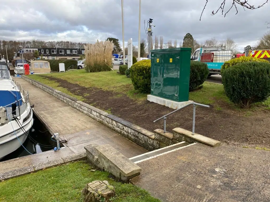
Low-voltage infrastructure design and installation for new EV charger at Windsor Marina for Aqua superPower
 Projects
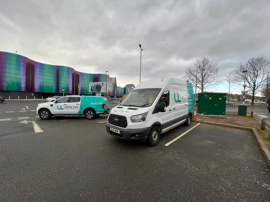
Low-voltage connection and feeder pillar installation to feed new EV charger at Merry Hill, West Midlands for Zest
Maximise the performance of your grid connections and electrical infrastructure
We help you navigate complex connection requirements, optimise network capacity, and extend the life of your electrical assets.
Contact our experts